When a Match Became a Bracket
Knockout brackets turn a field of entrants into a visible route to a champion. Learn how rounds, byes and seeding shape the draw and its practical decisions.
The common mistake in explaining knockout brackets is to treat the diagram as the invention, rather than the record of a decision: a defeated entrant leaves, and the winner advances. That distinction matters because the familiar chart does not identify a single historical moment when matches first became a bracket. It shows how organisers made elimination legible once they had chosen it.
The match rule
In a knockout competition, losing ends an entrant’s run. Winners advance through successive rounds until the final; the bracket draws those possible pairings as a narrowing route. Its first job is not to predict who will win, but to show what each result changes.
That makes a bracket different from a league table. A league accumulates results across repeated fixtures, while a knockout draw records a sequence of immediate contests. This article concerns the bracket as a way to display that sequence, not a verdict on which format gives the fairest measure of sporting ability.
Drawing the route
Successive elimination can be organised without a diagram. A chart of connected lines simply makes rounds and possible opponents visible in one place, which is useful to competitors, organisers and spectators. It also becomes a record of which route was taken after the matches are played.
There is no sound basis here for assigning the bracket a single birthplace or date of arrival. Instead, its practical appeal is straightforward: the organiser can publish pairings, show who advances and make the remaining route comprehensible. The history worth stressing is therefore the format’s function, not an unsupported claim that one institution or event made it universal.
Uneven fields
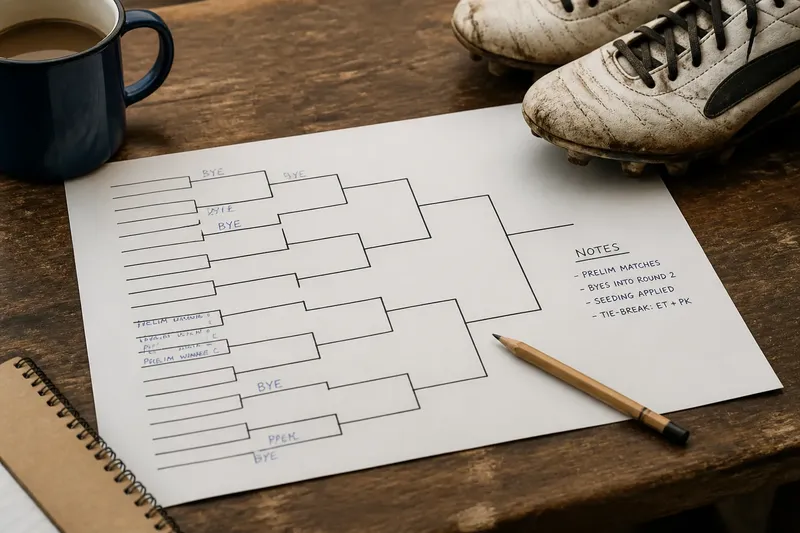
A draw divides most neatly when every entrant can be paired in each round. When the field does not divide evenly, organisers can hold preliminary matches or assign byes into a later round. A bye is permission to skip a round, not a victory; the chart should make that distinction plain.
Seeding is separate. It places entrants in specified positions according to a stated ranking or other published criteria, often to keep highly ranked entrants apart in early rounds. Seeding does not itself excuse anyone from playing, and a bracket cannot make the underlying ranking judgement disappear.
Say a school has twelve teams and one afternoon for its main draw; these numbers are invented for illustration. The organiser sets four preliminary matches, with the four winners joining the other eight teams in a sixteen-place bracket. Four places remain empty as byes, so the chart must show which teams enter later and how the preliminary winners are assigned; the resulting route is readable, though some teams play fewer matches.
Questions about brackets?
Why does a knockout bracket narrow?
Each completed match removes its losing entrant, leaving fewer competitors for the next round. The final pairs the last two remaining entrants, and its winner takes the title under the stated rules.
What is the difference between a bye and a seed?
A bye skips an entrant past a round because of the draw’s structure. A seed is a placement based on published criteria, and a seeded entrant still plays unless the rules separately give that entrant a bye.
How do organisers handle an uneven draw?
They can use preliminary matches to reduce the field or give selected entrants byes into a later round. The published draw should identify who plays, who enters later and how preliminary winners are placed.
Checking the draw
Before play begins, organisers can use this checklist to make the bracket understandable. Each observation points to a decision, with an alternative if the arrangement is unclear.
- Check the confirmed entrant list; if the count fits the planned rounds, publish that draw, but if it does not, add preliminary matches or explain the byes.
- Check every bye’s recipient and entry round; if both are visible, retain the placement, but if either is unclear, revise the chart before announcing it.
- Check whether seeding is used and what criteria set it; if the criteria are published, apply them consistently, but if they are not, remove seeds or publish a defensible method before drawing.
- Check how preliminary winners enter the next round; if each route is named, keep the assignments, but if not, redraw or state the placement method before the first match.
- Check the rule for a match that finishes level; if the competition rules specify a permitted tie-break, publish it, but if they do not, ask the governing body before play rather than improvising afterwards.
- Check where the official draw and changes will appear; if participants can find one current version, use it, but if not, choose a single noticeboard or online page and direct everyone there.
It is not worth forcing every bracket into a visually symmetrical shape. Neat lines cannot remove the unevenness created by a bye or explain why a seed was placed where it was. Clear rules do more useful work.
What the chart shows
A bracket is a map of possible pairings, not a forecast. One side may contain a tougher sequence than another, and the chart alone cannot settle whether the draw was well balanced. It can, however, show the route participants must follow and make changes easier to spot.
That visible route explains why knockout brackets remain useful to organisers with a fixed venue, a limited event window or a set number of match slots. Knockout brackets make progression easy to follow, provided the rules behind the lines are stated plainly. The last useful detail is often the least dramatic: post the current draw where everyone can check it before assuming a line on the page means what they think it means.